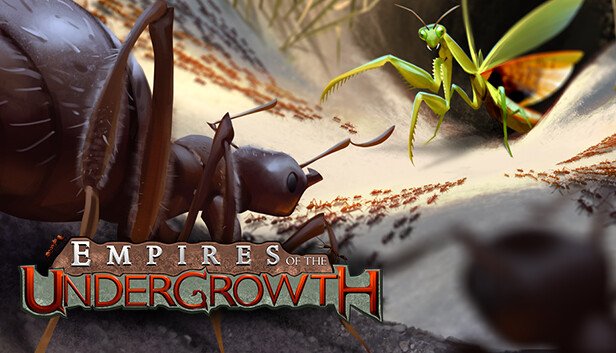
Empires of the Undergrowth Beginner Guide: Your Nest, Food and First Formicarium
On this page
Short answer: In Empires of the Undergrowth you don’t steer single ants: you dig out your nest, place brood tiles to raise ants and food storage to keep food, and send ants around with pheromone markers. In the story, missions pay food, territory and Royal Jelly into your formicarium, the lab colony you take through every chapter. Replay early missions to stock up before each formicarium challenge, and never let the queen die.
The game modes
- Story (campaign): documentary-style missions plus your persistent formicarium colony of gene-thief ants (Formica ereptor), which borrows units from the other species.
- Custom games: classic skirmishes against the AI and other setups, reached from Play → Custom Game. Good for practice.
- Challenge mode: unlocks once you clear a stage. It adds more enemies and pays more food, Royal Jelly and territory.
- New Game Plus: unlocked after the last formicarium challenge. It restarts the story with your unlocks, adaptations and Royal Jelly, and gets harder each cycle.
How the formicarium works
- You start with a lone queen, a few workers and almost no food.
- Open missions with the button at the top left. Each mission pays territory, food and Royal Jelly into the formicarium; you choose which one to focus on, but you get all three.
- Spend Royal Jelly to unlock units and adaptations, and territory to dig out more of the formicarium.
- Beat the formicarium challenges (survive waves, defeat an enemy colony, defeat Titans) to move the story on.
Because the formicarium gets almost no food on its own, mission rewards are your main income. Replaying early missions, and their challenge versions, is the standard way to build up before a challenge.
Building the nest
A colony starts with the queen and a few workers in the queen chamber. Workers handle digging, then building, then moving eggs, on their own.
| Tile | What it does |
|---|---|
| Brood (nursery) | Each tile raises one ant at a time and adds to your population cap. Workers carry eggs from the queen to empty brood tiles. |
| Food storage | Holds food; capacity grows when you upgrade it. When storage is full, food is dropped on the ground. |
| Highway | Makes ants move faster through the nest. |
- You can only dig into the black (unexcavated) area. Digging into a cavern opens all of it and releases whatever lives inside. A red “!” underground means an aggressive enemy; green markers mean food or harmless creatures.
- Same-type tiles next to each other form a chamber, and the ants raised in one chamber form one group.
- Tiles go up to level 3. Neighbouring tiles of the same type and highways count towards upgrades, so build in tight clusters.
- Deleting a tile refunds part of its cost, but the ants linked to it die.
- Keep nurseries away from the main paths and front lines. Some enemies, such as slave-maker ants, raid them.
Food: where it comes from
Food pays for new tiles, upgrades and every new ant, and eggs only grow while you have food. Losing a big fight therefore costs a lot of food to replace.
- Workers automatically bring visible food back to storage. Small items are carried whole; big ones are cut up by several ants.
- Woodworms, woodlice and seeds are common early food. Aphids give honeydew.
- Killing enemy creatures adds food.
- Leafcutter ants work differently: they harvest leaves and grow fungus instead of eating insects.
Controlling your ants
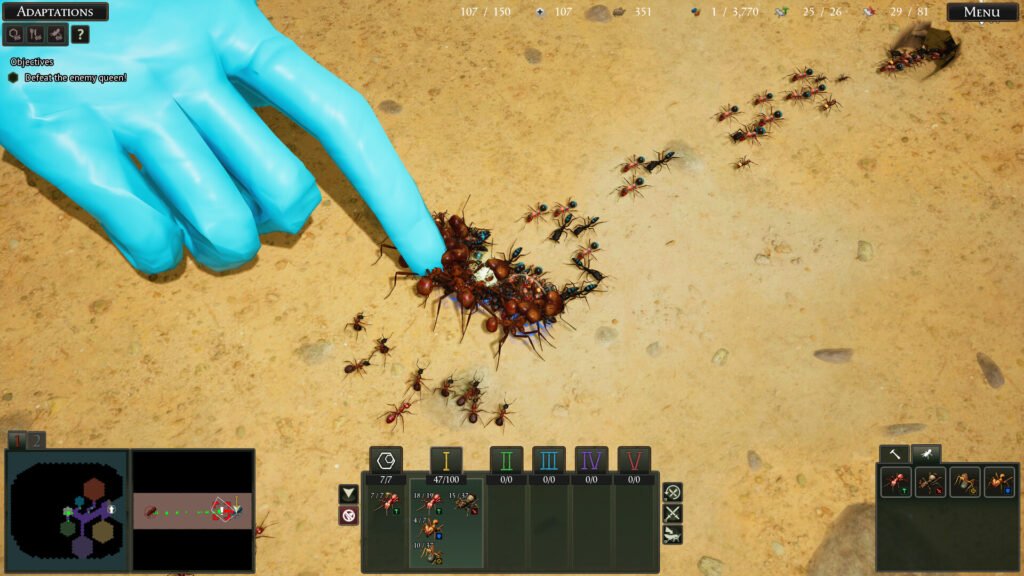
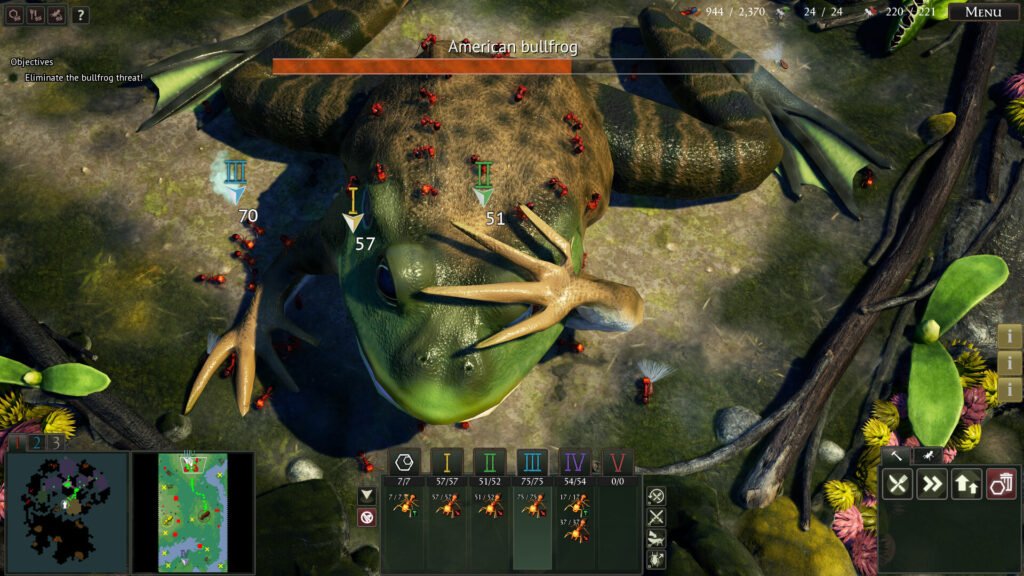
- You command groups, up to five (I–V), by placing pheromone markers: right-click the map or the minimap.
- Each group can be set to gather only, fight only, or both.
- Ants attack enemies they can see. Workers carrying food ignore enemies.
- Workers dig, build and gather; soldiers cannot do nest jobs. Keep enough workers in the nest group so jobs and respawns keep running.
- Win fights with numbers: surround enemies and keep your groups together. Ants can climb onto big enemies such as Titans.
- The queen only lays eggs and you lose if she dies. The screen flashes red when she is badly hurt.
Ant species by chapter
| Chapter | Species | Setting |
|---|---|---|
| 1 | Black ants (Formica fusca), a basic tutorial species | European woodland |
| 2 | Wood ants (Formica rufa), with formic-acid shooters | European beach |
| 3 | Leafcutter ants (Atta cephalotes), whose majors draw enemy attacks | South American rainforest |
| 4 | Fire ants (Solenopsis invicta) | Swamp |
| 5 | Matabele ants (Megaponera analis), which raid termites for food | Savannah |
| 6 | Termites (Macrotermes bellicosus), which farm fungus | Savannah |
With wood ants, put melee soldiers in front so they tank for the shooters. Bullet ants are a reward for finishing the campaign.
Checklist for your first hours
- Play the early story missions and pick rewards that fill your weakest resource.
- Build brood and food storage in tight clusters and upgrade them.
- Keep nurseries out of the path of attackers.
- Upgrade your ants: weak ants that die faster than you can replace them lose games.
- Stock up on food before every formicarium challenge.
- Replay missions and challenge mode when a challenge feels too hard.
More guides
For what players and critics think of the game, read our Empires of the Undergrowth review. All our coverage is on the Empires of the Undergrowth page.
Sources
- Empires of the Undergrowth Wiki (Hooded Horse): Story Mode, Basic Mechanics, Black Ant, Wood Ant
- Empires of the Undergrowth Wiki (Fandom): Basic Mechanics
- Prima Games: beginner story progression, food and Royal Jelly guides
- ItemLevel: Empires of the Undergrowth complete beginner’s guide
- Steam community guides: surviving in the Undergrowth, species guide
- Gaming.net: Empires of the Undergrowth review
- Steam store page for Empires of the Undergrowth
Last checked against sources: 14 November 2026.